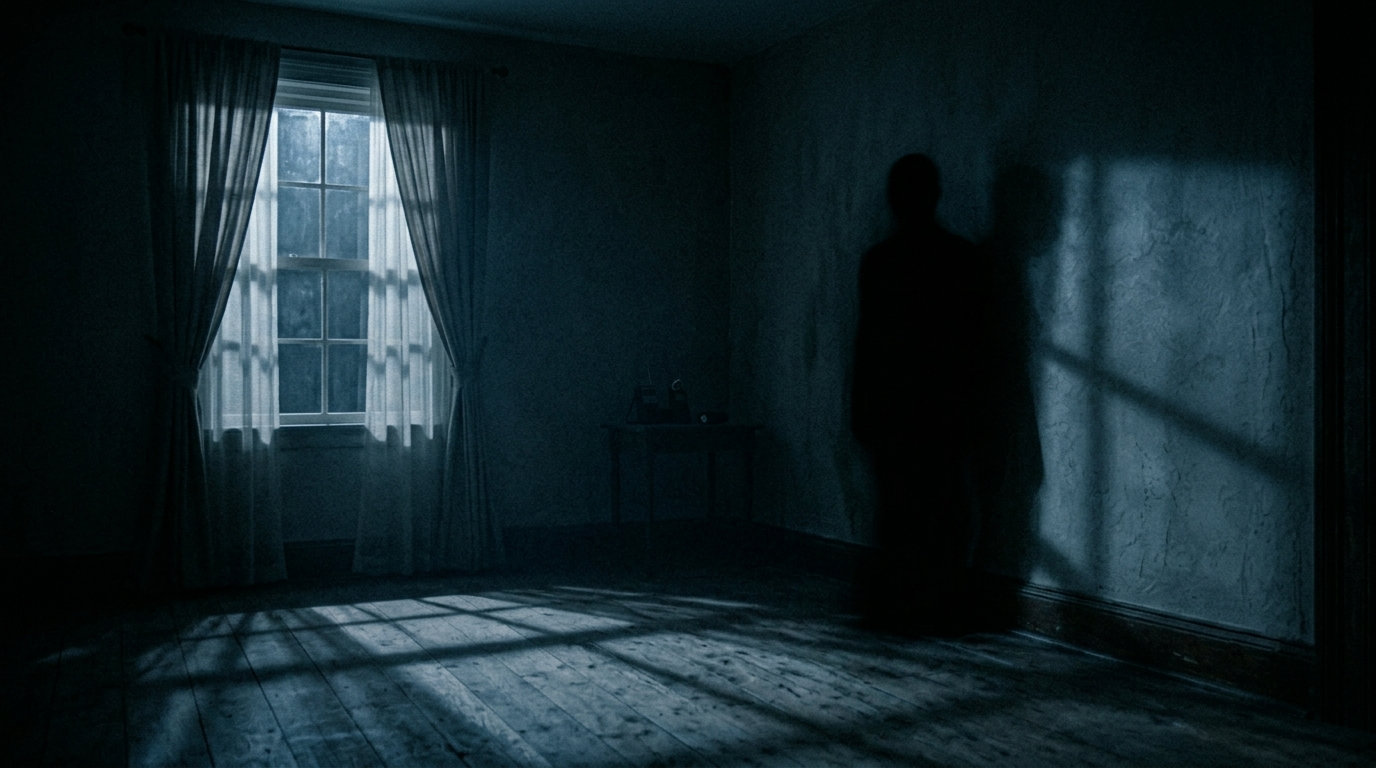
Shadow People: The Darkness in Your Peripheral Vision
They appear in the corner of your eye, darting away as soon as you look. Are Shadow People malevolent entities, or is it just your brain playing tricks on you? Explore the mystery behind these pitch-black silhouettes.
Shadow People: The Darkness in Your Peripheral Vision
You’re sitting in your living room at midnight. You feel that sudden, unmistakable chill. You glance toward the hallway, and for a split second, you see a silhouette, darker than the darkness around it, darting across your vision. Before you can focus, it's gone.
The Observer’s Rule: If you see something move in the corner of your eye, don't jump immediately. The human brain is hardwired to detect movement as a survival mechanism, often turning shadows into shapes. Your job is to determine if what you saw was biological or something else.
Shadow People are among the most commonly reported paranormal phenomena worldwide. Unlike ghosts, which are often described as translucent figures from a specific era, Shadow People are almost always described as solid, pitch-black silhouettes that lack facial features. They don't just appear; they loom.
Common Manifestations
While every experience is unique, witnesses often report similar patterns of behavior:
- The Corner Dweller: These entities stay at the very edge of your vision. As soon as you turn your head to look directly at them, they vanish.
- The Watcher: A stationary shadow that stands in doorways or at the foot of the bed, simply observing. This is most frequently reported during episodes of sleep paralysis.
- The Hat Man: One of the most terrifying and specific manifestations. Witnesses worldwide describe a tall shadow silhouette wearing a distinct wide-brimmed hat, often a fedora, and a long trench coat. Unlike others, he doesn't always run. He stands his ground and radiates an intense, malevolent energy.
Science vs. The Supernatural
To be a good investigator, you have to look at the biological explanation first. Many "Shadow Person" encounters coincide with Sleep Paralysis. This is a transitional state where your body remains asleep while your brain wakes up, often accompanied by vivid waking hallucinations and a feeling of intense chest pressure.
⚠️ Rookie Mistake: Attributing every midnight shadow to an entity immediately. Always check the environment for "low-light pareidolia", which is the brain's tendency to see faces or human shapes in random patterns like tree branches, shadows from curtains, or furniture silhouettes.
However, for many investigators, science doesn't explain everything. When multiple witnesses report the exact same silhouette in broad daylight or in a room with no light sources capable of creating such a shape, we move from biology into the realm of true paranormal investigation.
Some researchers even theorize that Shadow People aren't spirits at all, but rather interdimensional travelers. These are beings from a parallel reality whose brief passage through our dimension is perceived only as a fleeting shadow.
Shadow People vs. Other Entities
It is easy to confuse different entities when you are in a state of fear. Use this guide to help differentiate what you might be encountering:
| Feature | Shadow Person | Poltergeist | Doppelgänger |
|---|---|---|---|
| Appearance | Solid black silhouette | Often invisible or energetic | Looks exactly like a known person |
| Primary Action | Observing / Darting | Moving objects / Noise | Mimicking behavior |
| Feeling | Intense dread/anxiety | Chaotic / Destructive | Uncanny / Psychological |
How to Document the Unseen
Since Shadow People are, by definition, dark and often move quickly, they are notoriously difficult to capture on standard camera gear. If you are attempting to gather evidence, try these field methods:
- 📹 Use Infrared (IR) & Full-Spectrum: Standard video often fails because the camera sensor tries to compensate for the dark. Using a dedicated night-vision camcorder with strong IR illuminators can sometimes catch the silhouette as a distinct void or anomaly in the infrared spectrum.
- 📸 Long Exposure & Motion Triggers: If you suspect a presence is stationary or frequents a specific doorway, set up a camera with a motion-activated trigger or run a continuous low-ISO, long-exposure capture to catch the imprint of the shadow.
- 📝 Contextual Logging: Always note the exact time, your own fatigue levels, and any recent changes in the room's environment. True evidence is built on data, not just fear.
In the realm of the unexplained, remember: curiosity is your greatest tool, but skepticism is your shield.